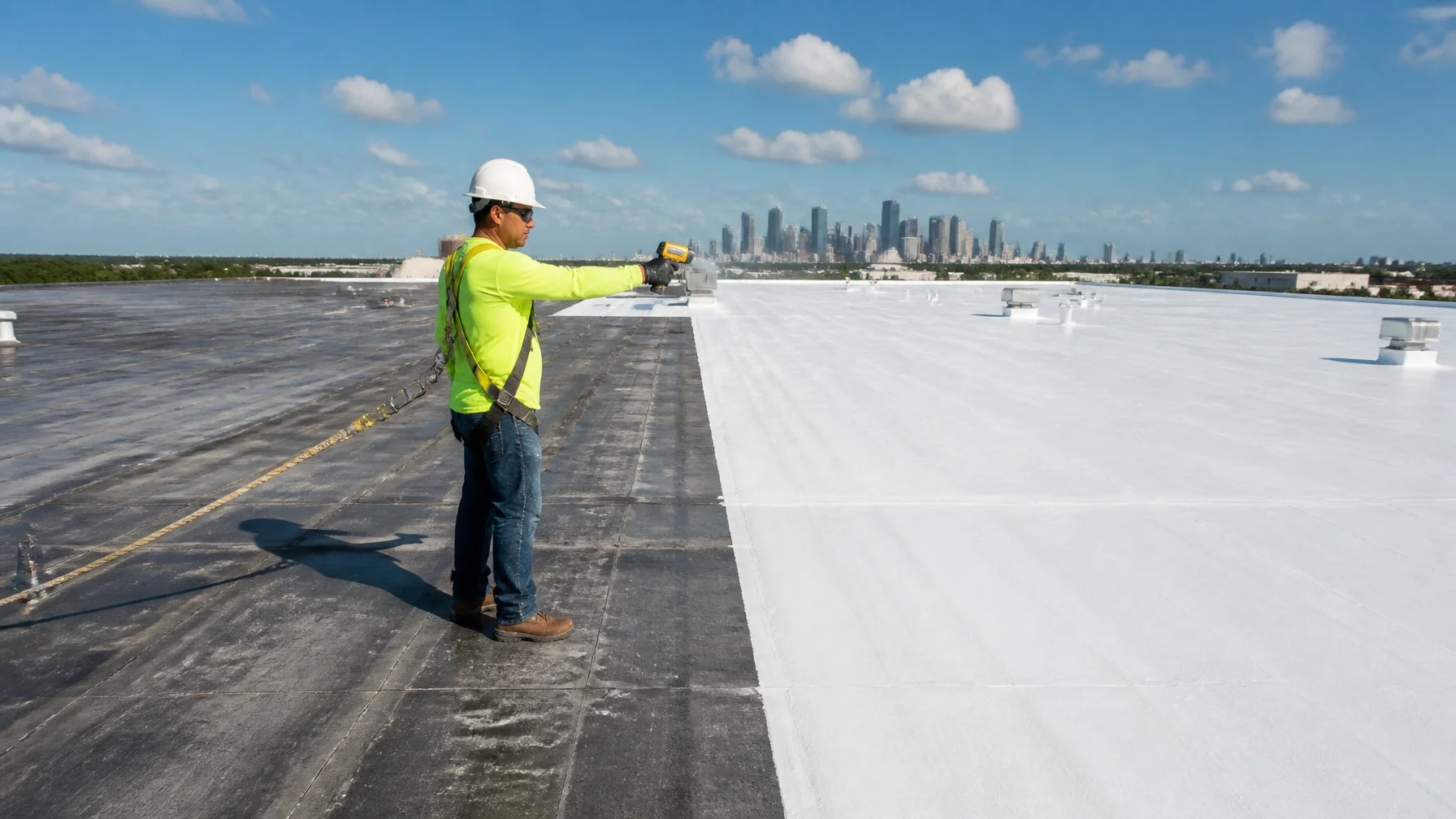
Does a Reflective Roof Coating Really Help With Houston Heat?
Houston and the surrounding metro area are dealing with prolonged extreme heat, high heat indexes, intense UV exposure, high humidity, and long cooling seasons. Commercial and industrial districts add another problem. Dark roofs, pavement, loading areas, and equipment create localized heat islands that stay hot long after sunset.
For commercial property owners, that heat shows up in three places:
Higher cooling demand
More strain on HVAC equipment
Faster degradation of the roof membrane
The Houston Cool Houston Plan documented commercial roof surface temperatures reaching approximately 150°F to 180°F during summer conditions. A reflective roof coating can reduce that heat load. But it must be installed on the right roof, over the right substrate, for the right reason.
Stop Treating a Hot Roof as Just a Roof
A reflective roof coating is not simply white paint. A properly specified elastomeric, silicone, or other cool roof coating system is designed to manage solar radiation and protect the roof assembly.
The coating works through three related properties.
1. Solar reflectance
Solar reflectance measures how much incoming sunlight the surface reflects away.
A dark roof absorbs more solar energy. A white or light-colored reflective coating sends more of that energy back into the atmosphere before it becomes heat in the roof system.
The difference is significant during a Houston afternoon. A dark roof can become dramatically hotter than the surrounding air. A high-reflectance surface stays closer to ambient conditions.
2. Thermal emittance
Thermal emittance measures how effectively a surface releases the heat it does absorb.
High solar reflectance is important. High thermal emittance matters too. A coating that reflects sunlight and releases absorbed heat performs better than one that only appears light in color.
3. Solar Reflectance Index
The Solar Reflectance Index, or SRI, combines solar reflectance and thermal emittance into one measurement. Higher SRI generally means a cooler roof surface under solar exposure.
When reviewing a product, ask for documented:
Initial solar reflectance
Aged solar reflectance
Thermal emittance
SRI
Application thickness
Testing and rating information
Measure the Heat Before You Promise Savings
The answer to “does roof coating reduce heat?” is yes, but the useful question is how much heat is reaching your building.
A cooler roof surface does not automatically mean the same percentage reduction in your total utility bill. Interior heat gain depends on the entire roof assembly, including:
Insulation type and condition
Roof deck construction
Air leakage
HVAC efficiency
Building operating hours
Interior equipment loads
Door openings and ventilation
Roof orientation and shading
A reflective coating lowers the heat absorbed at the roof surface. That can reduce the heat conducted through the roof assembly and lower the cooling load. It cannot compensate for missing insulation, undersized HVAC equipment, open loading dock doors, or poor building envelope performance.
This distinction matters for Houston warehouses and manufacturing facilities. Some buildings are fully conditioned. Others have limited air conditioning or rely on ventilation. The energy and comfort impact will differ.
That is why Primetime Roof Coatings & Restoration uses a documentation-first process. Infrared readings, moisture testing, roof assembly observations, drainage conditions, and photographs should support the recommendation.
Protect the Membrane From Houston UV and Thermal Shock
Houston heat does more than make the building uncomfortable. It accelerates roof aging.
Repeated heating and cooling cause roofing materials to expand and contract. This thermal movement can stress seams, fasteners, flashing, penetrations, and transitions. Storms add another layer of risk through wind-driven rain, debris, and rapid wetting.
Intense UV exposure can also cause:
Surface chalking
Loss of flexibility
Membrane brittleness
Cracking around seams and penetrations
Premature degradation of exposed materials
A properly selected coating creates a continuous protective layer over a prepared roof surface. It can reduce direct UV exposure and moderate surface temperature swings. That protection may extend the usable service life of a structurally sound roof.
It does not reverse saturated insulation, failed decking, major structural movement, or widespread membrane failure.
Choose the Coating Based on the Roof, Not the Color
White and light-colored coatings provide strong reflective performance, but color is only one part of the decision.
Elastomeric coating
Elastomeric coating systems remain flexible and can accommodate normal roof movement. They are commonly considered for certain metal, modified bitumen, built-up, and compatible single-ply roof applications.
The roof must be clean, dry, sound, and properly prepared. Adhesion testing and detail work are critical.
Silicone roof coating
Silicone roof coatings are often considered for low-slope commercial roofs exposed to Houston humidity and ponding water. Silicone can provide strong UV resistance and water resistance, but the existing roof still needs to be evaluated.
Ponding water cannot be ignored. Even when a coating system is water-resistant, blocked drains, poor slope, and damaged substrate can create broader roof problems.
TPO roof coating
TPO roof restoration may be appropriate when the existing TPO membrane is still structurally sound but has aging seams, surface wear, or localized defects. Compatibility, cleaning, adhesion, and manufacturer requirements must be confirmed before coating.
Metal roof coating
Metal roof coating can help protect aging panels, fasteners, seams, and areas with surface corrosion. Rust remediation and fastening repairs must happen before the coating is applied. Covering active corrosion without treating it is not restoration.
SPF roofing
Spray polyurethane foam can add insulation value and help address certain drainage and thermal performance issues. It is a different approach from a thin reflective coating. Warehouse and manufacturing operators should compare both options based on insulation needs, roof slope, moisture conditions, and budget.
Fix Ponding and Soiling Before You Expect Results
Houston receives heavy rain, high humidity, and storm events that can leave commercial roofs dirty and wet. Dirt, biological growth, exhaust residue, and airborne particles reduce surface reflectance over time.
A white roof that becomes heavily soiled will not perform like a clean white roof.
Your maintenance plan should address:
Drain and scupper cleaning
Debris removal
Ponding water
Seam and penetration inspection
Coating wear and exposed substrate
Flashing and termination points
HVAC curb conditions
Areas with recurring biological growth
Reflective coating is a roof system improvement, not a maintenance exemption.
Know When Coating Is Better Than Replacement
Reflective coating fits a restoration plan when:
The roof deck is structurally sound
Moisture testing shows the insulation is largely dry
The existing membrane has recoverable service life
Leaks are localized or related to repairable details
The substrate can accept the selected coating
Drainage problems can be corrected
The owner needs minimal disruption
A full replacement would create unnecessary cost and waste
Replacement may be more appropriate when:
The deck is structurally compromised
Insulation is extensively saturated
The roof has widespread delamination
The existing system cannot accept a coating
Drainage cannot be corrected
Multiple prior repairs have failed
The roof has reached the end of its recoverable service life
A restoration project can cost substantially less than a full tear-off when the roof qualifies. It can also reduce disruption, avoid disposal of existing roofing materials, and help keep operations running.
Ask These Questions Before Hiring a Contractor
Before selecting a commercial roof coating contractor in Houston, ask:
What roof type and membrane do you see?
Did you perform moisture testing?
Were infrared images or other diagnostic records collected?
What areas need repair before coating?
How will you address ponding water?
What are the product’s solar reflectance, thermal emittance, and SRI values?
What application thickness will be installed?
Is the coating compatible with my existing roof?
What surface preparation is included?
What maintenance is required to preserve performance?
What warranty covers labor and materials?
Is the warranty transferable if the property is sold?
What is the cost of restoration compared with replacement?
How will the project affect tenants, employees, loading docks, and daily operations?
A professional assessment should give you documented findings and practical options. Not a generic promise that a white roof will solve every energy problem.
Primetime Roof Coatings & Restoration provides documentation-first commercial roof assessments, restoration planning, elastomeric and silicone coating systems, TPO restoration, metal roof coating, and SPF roofing support throughout Houston and the Greater Houston metro area, including Conroe, The Woodlands, Katy, Cypress, Spring, Pasadena, Baytown, and surrounding communities.
Get a Documented Answer Before You Spend
If you are evaluating a reflective roof coating Houston property owners can use to reduce heat exposure, protect the membrane, and avoid unnecessary replacement costs, call Primetime Roof Coatings & Restoration at 832-447-1170 for a professional commercial roof assessment. No pressure. No obligation. Just documented findings and clear options for your building.
My Commercial Roof Needs Work But I Can't Afford a Full Replacement: What Are My Options?
You know your commercial roof needs work. You also know a full tear-off and replacement may not fit this year’s capital budget.
That does not mean you should approve the lowest invoice.
The roof assembly must be evaluated first. A targeted repair may be the right answer. A phased plan may spread spending across multiple budget cycles. A restoration or coating system may extend service life without a tear-off. In other cases, full replacement is necessary because the roof has widespread moisture, structural damage, or drainage problems.
The correct decision depends on the condition of the membrane, insulation, roof deck, seams, flashings, penetrations, and drainage system.
Primetime Roof Coatings & Restoration is a Houston-based, licensed and insured commercial roofing contractor with more than 30 years of experience. Our owner and team bring more than 11 years of spray polyurethane foam research and development experience at BASF, Carlisle product development experience, and field leadership on major commercial SPF projects, including the 440,000-square-foot Louisiana Superdome.
That technical background matters when you need a cost-conscious recommendation that is still appropriate for the roof.
Your Four Commercial Roof Repair Options
1. Targeted Repair: Fix Isolated Failure Points
Targeted repair is usually the most affordable commercial roof repair option in Houston when the damage is genuinely localized.
It may include:
Repairing a failed TPO seam
Replacing damaged flashing
Sealing pipe boots, curbs, and penetrations
Repairing loose metal roof fasteners
Treating localized rust
Patching a limited membrane puncture
Clearing blocked drains and scuppers
Replacing small areas of wet insulation
This approach works best when:
The roof is not failing across multiple areas
Insulation is mostly dry
The roof deck is structurally sound
Ponding water is limited or correctable
The membrane still has useful service life remaining
Targeted repair is not the same as applying roofing cement over the spot where water appears inside. Water can travel beneath a membrane or through insulation before reaching the ceiling.
If your commercial roof keeps leaking after repair, the problem may be incomplete diagnosis rather than poor luck.
2. Phased Repairs: Control Capital Spending Over Time
Phased repairs can make sense when the roof has several problem areas but does not require immediate full replacement.
Instead of treating every roof section at once, your contractor documents the condition and prioritizes work by risk.
A practical phased plan may address:
Active leaks affecting occupied space, inventory, electrical systems, or equipment
Open seams and failed flashings
Drainage restrictions and ponding water
Saturated insulation in defined areas
Roof edge, coping, and wind damage
Preventive maintenance on areas that remain serviceable
This approach can help facility managers manage capital spending without ignoring known risks. It also gives you a documented timeline instead of reacting to every leak as an emergency.
Phasing is not an excuse to postpone serious structural problems. If the deck is deteriorating or moisture is widespread, delaying corrective work may increase the eventual cost.
Ask for each phase to include:
A defined roof area
The failure points being addressed
Photos and moisture findings
Expected service-life benefit
Warranty terms
The consequence of delaying that phase
This is especially useful for large facilities in Greater Houston, Katy, Cypress, Spring, and Baytown where roof areas may cover tens of thousands of square feet.
3. Restoration or Roof Coating: Extend the Existing Roof
Commercial roof restoration Houston property owners often consider coating systems when the existing roof is aging but fundamentally serviceable.
A restoration project typically includes inspection, cleaning, preparation, repairs, reinforcement of seams and penetrations, primer where required, and application of a compatible coating system. Depending on the roof, options may include silicone, elastomeric, or SPF systems.
A properly selected coating may:
Add a seamless waterproofing layer
Reduce UV-related deterioration
Improve reflectivity and reduce heat absorption
Extend useful roof life
Avoid tear-off and disposal costs
Reduce operational disruption
Support 10, 15, or 20-year transferable warranty options when the system and installation qualify
Reflective coating systems may also reduce annual energy use by approximately 10% to 15%, depending on the building, insulation, HVAC equipment, occupancy, and existing roof condition.
Restoration is often considered in the roof coating vs. roof replacement cost commercial decision because it can reduce upfront spending. However, coating is not a shortcut around roof failure.
Coatings may be appropriate when:
The roof deck is sound
The membrane is still attached and reasonably stable
Moisture is limited or can be removed
Seams and penetrations can be repaired
Drainage problems can be corrected
The surface can be cleaned and prepared
The proposed coating is compatible with the existing roof
Coatings are generally not appropriate over:
Widespread saturated insulation
Structural deck damage
Widespread membrane failure
Active movement or major delamination
Unresolved ponding water
Surfaces with poor adhesion conditions
Contamination that cannot be properly removed
Roof areas that cannot support a reliable coating bond
A coating can protect a sound roof assembly. It cannot replace rotten decking, remove widespread trapped moisture, or solve a drainage design problem by itself.
4. Full Replacement: Use It When the Roof Has Failed
Replacement is the correct option when restoration cannot provide a reliable roof system.
That may be the case when you have:
Widespread saturated insulation
Extensive membrane deterioration
Repeated repairs across the roof
Structural deck corrosion or damage
Severe drainage deficiencies
Widespread adhesion failure
Major storm or wind damage
A roof assembly at the end of its practical service life
Replacement costs usually include more than the new membrane. Your budget may also need to account for:
Roof size and layout
Existing roof type
Tear-off labor
Disposal fees
New insulation
Tapered insulation for drainage
Roof deck repairs
HVAC curbs and penetrations
Access restrictions
Safety requirements
Business disruption
Permit or code-related requirements
This is why there is no reliable universal answer to the question, “What is the commercial roof coating cost in Houston, Texas?” The same square footage can produce very different budgets depending on moisture, access, roof type, preparation, and warranty requirements.
Compare the Five-Year Cost, Not Just the First Invoice
When reviewing commercial roof repair financing alternatives in Houston, do not assume that financing is available or that a low first invoice represents the lowest total cost. Instead, compare the full financial impact of each option.
For a realistic comparison, ask what each option may cost over five or ten years.
Consider:
How many emergency repairs are likely?
Will leaks interrupt tenants, production, storage, or deliveries?
Is the roof consuming more energy because of heat absorption?
Will wet insulation continue damaging the deck?
Does the proposed work include a transferable warranty?
Will the building be sold or refinanced?
Are you correcting the cause or only managing symptoms?
A restoration that costs more than a single patch may still be the better investment if it reduces repeat leaks and postpones replacement. A replacement may be more economical than years of repairs if the roof assembly is already failing.
Houston Weather Makes Delayed Decisions More Expensive
Houston and surrounding metro areas expose commercial roofs to extreme heat, intense UV radiation, high humidity, heavy rainfall, hurricanes, wind-driven rain, and rapid thermal movement.
Those conditions accelerate:
TPO seam failure
Metal panel movement
Fastener loosening
Sealant breakdown
Flashing deterioration
Membrane shrinkage
Ponding-related damage
Corrosion around penetrations and roof edges
A roof that appears manageable during a dry inspection may perform very differently during a Gulf Coast storm.
That is why commercial roof repair in Conroe, TX should be approached with the same diagnostic discipline as flat roof restoration in Houston or commercial roof restoration in The Woodlands. The location changes the weather exposure, but the decision still depends on the roof assembly.
Owners in Pasadena may be comparing commercial roof repair Pasadena TX options after repeated rain events. A facility manager in Baytown may be dealing with wind and corrosion. A property owner in Katy or Cypress may be trying to preserve an aging TPO roof while avoiding tenant disruption.
The process should remain the same: document the condition, prioritize active failure points, and select work that matches the risk.
Build a Roof Maintenance Plan After the Immediate Work
The most effective way to extend the life of a commercial roof is to combine corrective work with scheduled maintenance.
Your roof maintenance plan should include:
Semiannual professional inspections
Additional inspections after major storms
Routine drain and scupper clearing
Documentation of ponding water
Inspection of seams, flashings, and penetrations
Fastener and panel checks on metal roofs
Moisture monitoring where previous leaks occurred
Updated roof maps and repair records
Clear warranty and maintenance requirements
This documentation helps you identify whether the roof is improving or simply accumulating patches.
Questions to Ask a Commercial Roofing Contractor
Before approving work, ask:
What evidence confirms the source of each leak?
Was the entire roof assembly inspected?
Were infrared imaging, moisture meters, or test cuts used?
Is the insulation dry, partially saturated, or broadly saturated?
Is the roof deck structurally sound?
What is causing ponding water?
Can drainage be corrected without replacement?
Is the existing TPO, metal, modified bitumen, or SPF system compatible with the proposed work?
Why is targeted repair, phased repair, restoration, coating, or replacement the best option?
What preparation is included?
What is excluded from the proposal?
What warranty covers labor and materials?
Is the warranty transferable?
How will the work affect operations, tenants, deliveries, and revenue?
What will the five-year and ten-year maintenance outlook look like?
Primetime Roof Coatings & Restoration takes a documentation-first approach. We evaluate whether targeted repair, phased repair, restoration or coating, or replacement is technically appropriate before recommending a scope.
Call 832-447-1170 to schedule a professional commercial roof assessment in Houston, Conroe, The Woodlands, Pasadena, Katy, Cypress, Spring, Baytown, or a surrounding Houston metro area. No pressure. No obligation. Just clear answers about the condition of your roof and the most practical path forward.
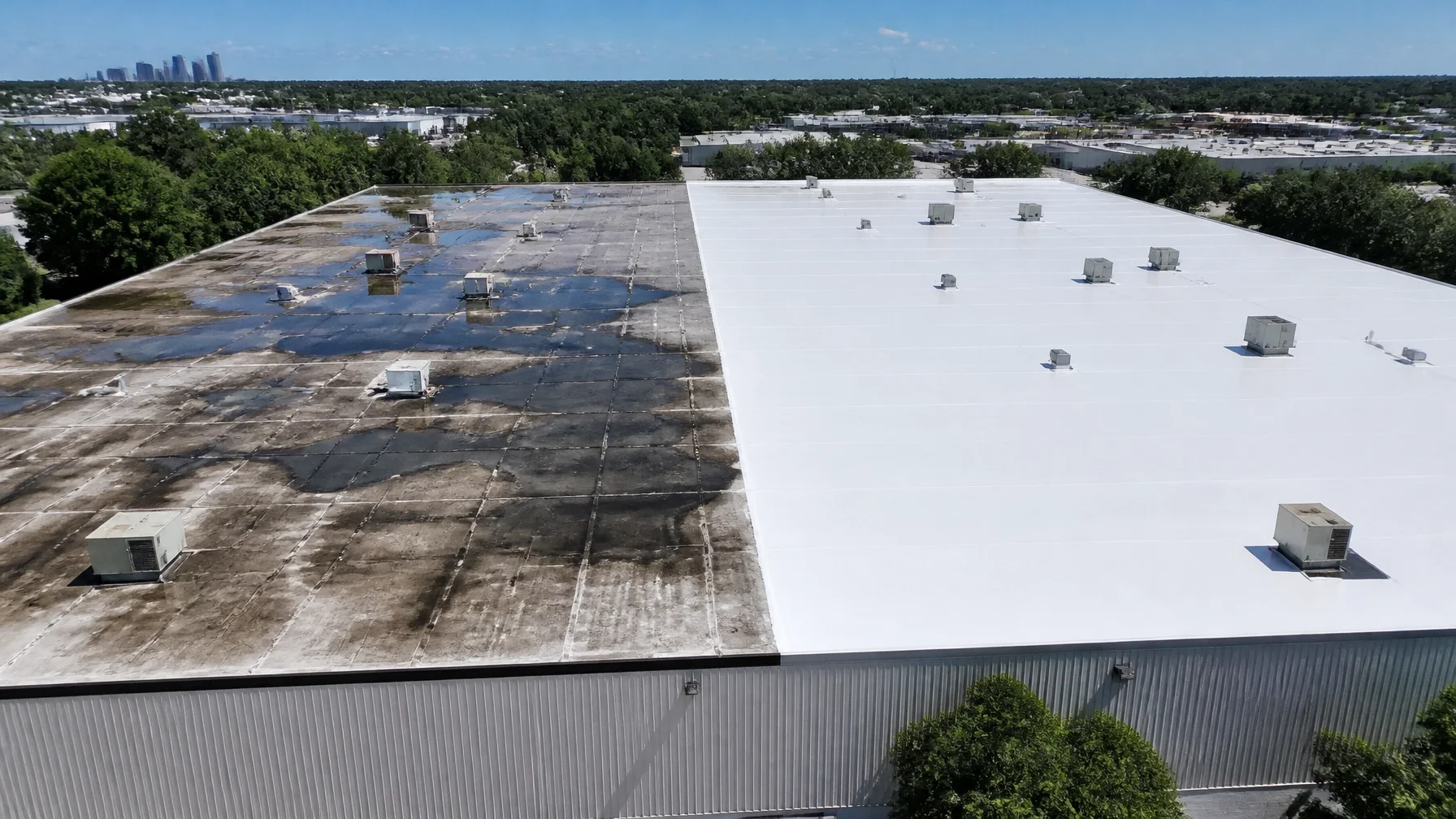
HOW TO FIX A LEAKING COMMERCIAL ROOF : WHAT HOUSTON PROPERTY OWNERS SHOULD DO FIRST
A leaking commercial roof is not a problem to postpone until the next budget cycle.
Water can move through insulation, travel along the roof deck, damage electrical systems, and appear inside your building far from the actual failure point. In Houston, heavy rain, humidity, intense UV exposure, storm debris, ponding water, and daily thermal movement put additional stress on flat, low-slope, TPO, and metal roofing systems.
Primetime Roof Coatings & Restoration takes a diagnostic-first approach to commercial roofing. Our owner’s hands-on experience with SPF systems, commercial roof coatings, and restoration helps property owners understand what is actually failing before they commit to a repair or replacement plan.
If you need commercial roof leak repair Houston property owners can approach logically, start with these steps.
Stop the Damage. Protect the Building First.
When water is entering your commercial property, your first responsibility is safety and damage control.
1. Keep people away from unsafe areas
Do not allow employees, tenants, or contractors to stand beneath:
Sagging or bulging ceilings
Wet electrical fixtures
Exposed wiring
Areas with active ceiling collapse risk
Slippery floors or standing water
If water is near electrical panels, outlets, lighting, servers, or machinery, isolate the area and contact the appropriate building or electrical professional. A roof leak can quickly become a safety issue.
2. Contain the water
Use buckets, totes, or other containers beneath active drips. Protect inventory, documents, equipment, and furniture with plastic sheeting. Move sensitive items to a dry area if it is safe to do so.
Remove standing water from interior floors when possible. This reduces slip hazards and limits damage to flooring, drywall, insulation, and stored materials.
3. Document the condition
Take photos and videos before cleanup changes the scene. Record:
The location of each interior drip
Ceiling stains, bubbling paint, or damaged drywall
Wet flooring, equipment, inventory, or furniture
The date and time the leak was discovered
Weather conditions, including recent storms or heavy rain
Temporary measures taken to reduce damage
Keep receipts for emergency supplies and water mitigation. This information can help your insurance carrier, adjuster, facility team, and roofing contractor understand the sequence of events.
Do Not Patch Directly Above the Drip
The visible drip is often not the actual roof leak entry point.
Water can travel horizontally beneath a TPO membrane, through insulation, along metal decking, around fasteners, or beside structural members. It may enter near an HVAC curb or parapet wall and emerge inside the building several feet away.
That is why simply applying roofing cement above the interior stain can produce a false sense of security. You may cover the symptom while leaving the actual failure open.
A professional commercial roof leak repair process should investigate the complete water path. That includes the roof surface, membrane seams, flashings, penetrations, drains, scuppers, parapet walls, fasteners, and edge details.
For concealed moisture, a qualified contractor may use:
Infrared thermography
Moisture meters
Core samples
Seam probes
Drainage inspections
Drone photography where appropriate
The goal is straightforward. Find the source. Determine the extent of moisture. Then match the repair to the condition of the roof.
Identify the Most Common Houston Roof Failure Points
Houston’s weather creates a predictable set of commercial roofing problems.
Failed TPO seams
Heat-welded seams can fail because of installation defects, age, membrane shrinkage, surface contamination, or repeated thermal movement. Once a seam opens, wind-driven rain can move beneath the membrane.
Deteriorated flashing
Flashing at parapet walls, HVAC curbs, vents, drains, pipes, and roof edges is one of the most common sources of commercial roof leaks. Sealants dry out. Metal shifts. Fasteners loosen. Small gaps become active leak points during heavy rain.
Ponding water
Flat roofs are designed with low slopes, but they still require effective drainage. Water that remains on the roof after a rain event increases weight and places extended stress on seams, flashings, insulation, and the roof deck.
Ponding can result from:
Blocked drains or scuppers
Settled insulation
Structural deflection
Poor original drainage design
Damaged gutters or downspouts
Debris buildup
A repair plan that ignores chronic ponding is incomplete.
Metal roof fastener and panel failure
Houston’s heat causes metal panels to expand during the day and contract as temperatures fall. Over time, this thermal movement can loosen fasteners, enlarge screw holes, break sealant bonds, and separate panel laps.
Rust around fasteners or seams is more than a cosmetic issue. It can indicate that water is already compromising the metal system.
Storm and wind damage
High winds and flying debris can puncture membranes, lift edge metal, damage coping, and pull apart seams. Even when a storm does not create an immediate interior leak, it may weaken the roof and allow water intrusion during the next rain.
Emergency Repair Versus Permanent Commercial Roof Repair
Emergency commercial roof repair is appropriate when water is actively entering the building or when a storm has created a new opening in the roof system.
Emergency work may include:
Temporary membrane patches
Tarping or dry-in measures
Temporary flashing repairs
Clearing blocked drains
Diverting water away from vulnerable areas
Protecting interior contents
Documenting storm-related damage
These steps are designed to stabilize the property. They are not always the permanent solution.
After the immediate threat is controlled, ask for a written follow-up assessment. It should identify the source of the leak, the affected roof areas, any trapped moisture, and the recommended long-term options.
Read If Your Roof Leaked Tonight: How Many Tenants Would Be Affected Tomorrow Morning? for more practical guidance on emergency leak response and commercial property risk.
Repair, Restore, or Replace?
The right solution depends on the condition of the entire roof assembly, not just the number of leaks.
A coating is not a universal answer. It cannot repair rotten decking, replace saturated insulation, or correct a structurally compromised roof.
Restoration may be a practical option when:
The roof deck is structurally sound
Moisture testing shows limited or manageable saturation
The existing membrane remains attached
Leaks are concentrated at seams, flashings, or penetrations
The surface can be properly cleaned and prepared
Drainage issues can be corrected or managed
The coating system is compatible with the existing roof
When those conditions are present, a properly installed elastomeric, silicone, or SPF restoration system can create a seamless waterproof barrier. Reflective coatings may also reduce rooftop heat transfer and help lower annual cooling costs by approximately 10% to 15%, depending on the building and HVAC system.
Roof restoration projects can often be completed in days rather than the longer schedule associated with a full tear-off. That matters when you manage a warehouse in Pasadena, a retail facility in Baytown, an office building in Katy, or an industrial property near Cypress, Spring, or The Woodlands.
For a deeper comparison, read Roof Coating vs. Roof Replacement for Self-Storage Facilities in Houston, TX. The same diagnostic principles apply to many commercial properties.
Questions to Ask Before Hiring a Roofing Contractor
Do not approve a repair based only on a verbal explanation or a photograph of one leak.
Ask your contractor:
Where is the confirmed source of the water intrusion?
How did you determine that location?
Is moisture present beneath the membrane or in the insulation?
Was the roof deck inspected for corrosion, rot, or structural damage?
Are the leaks isolated or spread across multiple roof areas?
What is causing ponding water, and how will it be addressed?
Is the proposed repair compatible with my existing TPO, metal, modified bitumen, or other roof system?
Would restoration be technically appropriate, or is replacement necessary?
What preparation is included before a coating is applied?
What warranty covers labor and materials?
Will the warranty be transferable if the property is sold?
How will the work affect tenants, employees, parking, deliveries, and business operations?
A responsible contractor should be able to explain the findings in plain language. You should receive photographs, moisture information when applicable, a defined scope of work, and separate options when both repair and restoration are viable.
Fix the Leak Before It Becomes a Roof Replacement
The best way to fix a leaking commercial roof is not to guess. Protect the building, document the damage, contain the water, and schedule a professional diagnostic assessment.
A localized failure may need a targeted repair. A weathered but structurally sound roof may be a candidate for restoration. A roof with saturated insulation, widespread membrane failure, or structural damage may require replacement.
Primetime Roof Coatings & Restoration provides professional commercial roof assessments throughout Houston and nearby communities. We evaluate the roof you have before recommending the solution you need.
Call 832-447-1170 to schedule a professional commercial roof assessment. No pressure. No obligation. Just clear answers about your commercial roof repair options.
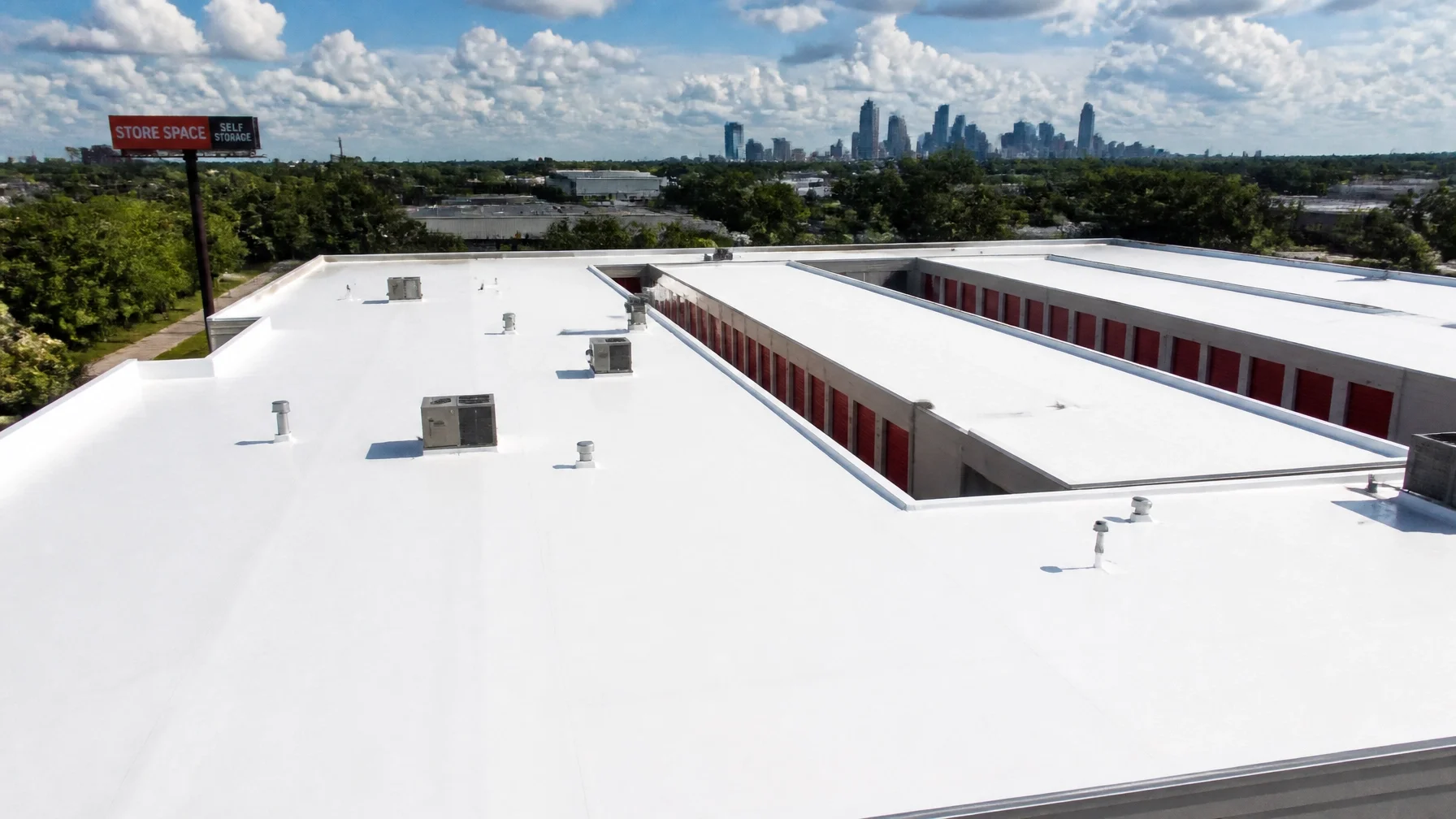
Roof Coating vs. Roof Replacement for Self-Storage Facilities in Houston, TX: Which Is the Better Investment?
Self-storage facilities in Houston face intense summer heat, UV exposure, heavy rainfall, and hurricane season. Those conditions can shorten the life of commercial roofs, leading many owners in Southeast Texas and Greater Houston to wonder whether a roof coating or a complete roof replacement is the better investment for their self-storage facilities.
When your commercial roof begins to show wear, the default reaction is often a full tear-off and replacement. But for large-footprint self-storage assets, replacement drains capital reserves and causes logistical headaches for tenants. At Primetime Roof Coatings & Restoration, drawing on Anthony's decades of hands-on expertise in spray polyurethane foam and advanced coating systems, we evaluate roofs through a diagnostic, engineering-first lens. Before you commit six figures to a tear-off, you need a clear breakdown of when a high-performance coating outperforms replacement, how local climate factors into your decision, and what financial logic dictates for your property.
What Is a Commercial Roof Coating?
A commercial roof coating is a fluid-applied, seamless membrane installed directly over your existing roof deck and substrate. Unlike traditional single-ply membranes or asphalt systems that rely on mechanically fastened sheets or hot asphalt kettles, a liquid coating cures into a monolithic, elastomeric barrier.
High-performance coatings typically fall into three categories: acrylics, polyurethanes, and high-solid silicones. In our region, silicone systems are particularly favored because they withstand ponding water and relentless UV bombardment without breaking down.
When applied to a structurally sound roof, a coating creates a waterproof seal over seams, flashings, and fastener heads. It stops active leaks and shields the underlying assembly from thermal shock. More importantly, it extends the service life of your existing roof by a decade or more while providing up to a 50 percent savings compared to a disruptive tear-off.
When Can a Self-Storage Roof Be Restored?
Restoration via roof coating is not a universal fix, but when applied to the right roof, it delivers exceptional return on investment. A self-storage facility roof is an ideal candidate for coating when specific structural and material criteria are met:
The underlying roof deck and framing remain structurally sound, with no sagging or structural compromise.
Core samples and infrared moisture scans confirm that insulation is dry and free of trapped water.
Leaks are localized around flashings, penetrations, seams, or fastener heads rather than stemming from widespread deck failure.
The existing membrane is weathered, chalking, or aging, but its physical foundation is intact.
You require minimal operational disruption so your tenants experience zero downtime or access blockages.
When these conditions align, coating the roof stops deterioration in its tracks. You avoid the heavy dumpsters, loud machinery, and debris associated with full tear-offs. Furthermore, a restored roof qualifies for 10, 15, or 20-year transferable warranties that cover both labor and materials.
When Is Roof Replacement the Better Option?
Pragmatism requires us to state clearly when a coating is the wrong choice. If a roof has passed the threshold of restoration, applying a coating is a waste of capital. Full roof replacement becomes the necessary path under specific circumstances:
Core samples reveal widespread moisture saturation throughout the insulation layers. When insulation holds water, a topcoat traps that moisture, accelerating deck corrosion from the inside out.
The structural deck, whether metal or wood, suffers from severe rust, rot, or structural compromise.
Leaks are systemic, migrating across the entire building footprint because the membrane has lost its structural integrity.
You have experienced repeated, failed patch repairs over many years, resulting in a patchwork assembly that no longer bonds reliably.
When structural decay is present, safety and asset protection demand a complete tear-off and a fresh assembly.
Roof Coating vs Roof Replacement Cost in Houston
Evaluating the financial logic of commercial roofing requires looking beyond initial contractor bids to examine long-term cash flow, asset valuation, and operational disruption.
While exact costs vary based on square footage, roof pitch, and material selection, commercial roof replacement requires extensive labor, heavy equipment rental, waste hauling fees, and disposal costs. Tearing off a large self-storage footprint and installing new insulation and membrane demands significant capital outlay and can disrupt tenant traffic.
Roof coating eliminates the tear-off and disposal phase. Because the existing roof stays in place as a stable base, labor hours drop significantly, and material is applied efficiently via spray or roller equipment. This translates to upfront cost efficiency of up to 50 percent compared to replacement.
Beyond initial savings, reflective coatings lower rooftop surface temperatures by up to 80 degrees Fahrenheit. This reduction in thermal transfer translates into tangible energy savings of 10 to 15 percent annually, reducing cooling loads on climate-controlled storage units and delivering continuous ROI year after year.
How Houston's Climate Affects Commercial Roofs
Houston's climate is notoriously harsh on commercial buildings. Self-storage facilities, with their expansive low-slope and metal roof footprints, bear the brunt of environmental stressors:
Intense Heat: Ambient summer temperatures push rooftop surface temperatures past 160 degrees Fahrenheit, accelerating the degradation of traditional roofing materials.
UV Exposure: Unrelenting ultraviolet radiation breaks down polymer chains in roofing membranes, causing embrittlement, cracking, and chalking.
Hurricanes and Heavy Rain: Tropical storms deliver torrential downpours and high wind uplift forces that test perimeter flashings, seams, and drainage systems.
High Humidity: Persistent moisture in the air fosters biological growth and stresses vulnerable lap joints.
Thermal Expansion: Rapid daily temperature swings cause building materials to expand and contract continuously, shearing fasteners and opening gaps at roof seams.
Standard roofing materials struggle under this cyclic punishment. High-grade elastomeric and silicone coatings create a seamless, flexible membrane engineered to move with thermal expansion while resisting UV breakdown and ponding water during heavy rain events.
Questions Every Self-Storage Owner Should Ask
Before making a final capital expenditure decision for your self-storage facility, ask your roofing contractor these critical diagnostic questions:
What do core samples and infrared scans reveal about our insulation and deck condition?
Are our leaks localized at penetrations and seams, or are they systemic across the entire building?
What is the specific mil thickness and chemical formulation of the proposed coating system?
Does the warranty cover ponding water, and is it backed directly by the manufacturer?
How will the restoration process impact tenant access, gate security, and daily facility operations?
Asking these questions separates professional asset managers from contractors looking for a quick sale.
Secure Your Self-Storage Investment Today
Choosing between roof coating and roof replacement does not have to be a gamble. At Primetime Roof Coatings & Restoration, we provide honest, diagnostic-first assessments that prioritize your operating budget and long-term asset value.
If you manage a self-storage facility in Houston, Greater Houston, or Southeast Texas, contact us today for a professional roof inspection. We will give you straightforward answers, clear data, and zero high-pressure sales tactics. Call us at 832-447-1170 to schedule your comprehensive roof evaluation.
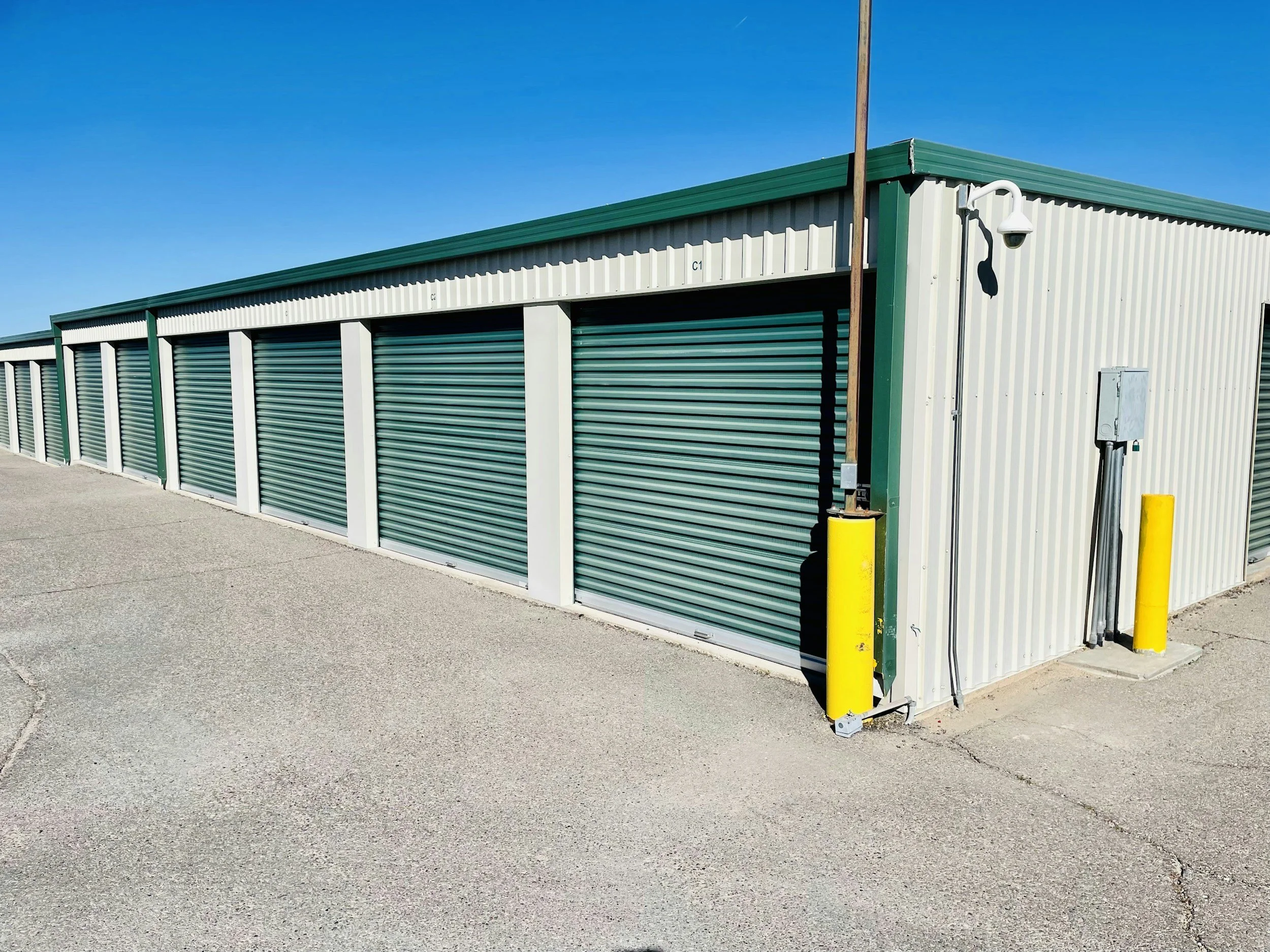
Why Self-Storage Roofs Leak (and What Owners Can Do Before It Becomes Expensive)
For self-storage facility owners and property managers across Houston, Katy, Cypress, Spring, The Woodlands, Pasadena, and Baytown, a roof leak is never just a minor maintenance annoyance. When water penetrates a self-storage unit, it destroys tenant belongings, triggers liability claims, damages facility reputation, and sparks costly emergency repairs. Whether your facility features aging metal standing seam panels or low-slope TPO membranes, understanding why leaks occur is the first step toward preventing catastrophic property damage.
Drawing on decades of hands-on experience in spray polyurethane foam and high performance commercial roof coatings, Anthony and the team at Primetime Roof Coatings & Restoration evaluate dozens of self-storage properties every year. Across the Texas Gulf Coast region, extreme thermal cycling, heavy downpours, and relentless UV exposure push roofing materials to their absolute limits. If you own or manage self-storage square footage in the Houston metropolitan area, recognizing the root causes of roof failure can save you tens of thousands of dollars in premature replacement costs.
1. Thermal Movement on Large Metal Spans
Many traditional drive-up self-storage buildings rely on long runs of metal roofing panels. While durable, these metal surfaces expand and contract daily under the brutal Texas sun. During peak summer afternoons, surface temperatures on metal roofs frequently exceed 160 degrees Fahrenheit, only to drop sharply during overnight cooling or sudden thunderstorms.This constant thermal expansion and contraction causes metal panels to shift. Over time, mechanical fasteners loosen in their holes, and factory sealants at panel overlaps shear apart. Once gaps form around fasteners or standing seams, wind driven rain from passing Gulf storms is forced directly into the storage bays below. Furthermore, standing water or standing debris in low-pitch metal valleys accelerates fastener corrosion. When rust takes hold around screw heads, the metal surrounding the fastener thins and fails. Without proactive maintenance, these microscopic gaps widen into persistent ceiling leaks that threaten tenant units.
2. Ponding Water and Seam Failures on Low-Slope TPO Roofs
Multi-story indoor self-storage facilities typically utilize low-slope or flat roofing systems, with thermoplastic polyolefin (TPO) being one of the most common membranes installed today. While TPO offers excellent initial reflectivity, low-slope roofs face unique hydraulic challenges, especially in flat terrain across Pasadena, Baytown, and south Houston.When roof drains clog with windblown debris, or when building settlement creates slight structural depressions, water accumulates in low spots. Industry standards classify water that fails to drain within forty-eight hours as damaging ponding water. On TPO membranes, prolonged standing water exerts continuous hydrostatic pressure on heat-welded seams. If an initial weld was slightly suboptimal during installation, or if UV degradation has weakened the membrane over the years, water penetrates the lap joints. Once moisture enters beneath the top membrane ply, it migrates laterally across the insulation board, often emerging inside a storage unit twenty feet away from the actual roof breach.
3. Neglected HVAC Units and Penetration Flashings
Every self-storage facility relies on extensive rooftop equipment, including ventilation fans, security conduit, drainage scuppers, and climate control HVAC units. Every single roof penetration represents a potential leak point if the surrounding flashing details fail. Rooftop HVAC units vibrate constantly during operation. This mechanical vibration breaks down mastic seals, cracks rubber pipe boots, and pulls pitch pockets apart. In the Houston climate, rapid temperature swings harden roofing sealants until they crack and separate from metal curbs.Facility managers often focus solely on the main roof membrane while ignoring these critical flashings. When neglected, water funnels directly around HVAC curbs, soaking ceiling insulation and dripping straight onto hallway floors or active storage units. Routine roof inspections must prioritize checking every penetration seal before rainy season arrives.
Actionable Steps for Self-Storage Owners
Waiting for tenants to report water dripping onto their furniture is an expensive operational strategy. By implementing a proactive roof management plan, you can protect your assets and maintain predictable facility budgets.
Conduct Bi-Annual Roof Health Assessments
Schedule professional roof inspections twice a year, ideally in the spring before severe storm season and in the fall after peak summer heat. An expert inspection identifies hairline seam separations, loose fasteners, and clogged drainage scuppers before water reaches the interior.
Clear Drains and Scuppers Monthly
Keep internal drains, gutters, and perimeter scuppers completely clear of leaves, dirt, and windborne debris. Unrestricted drainage eliminates standing water on TPO roofs and prevents accelerated corrosion in metal roof valleys.
Avoid Band-Aid Patch Jobs
Applying temporary roofing cement or generic caulking over leaking seams is a temporary fix that frequently causes more harm than good. Patch-only repairs trap moisture, complicate professional restoration efforts, and fail under heavy thermal stress.
Upgrade to High-Performance Coatings Before Replacement
If your self-storage roof is aging, showing surface wear, or developing scattered leaks, a full tear-off is rarely your only option. Advanced elastomeric and silicone roof coating systems create a seamless, monolithic waterproof membrane over existing metal or TPO roofs.Coating systems deliver exceptional financial and operational advantages for self-storage operators: Cost Efficiency: Restoring an existing roof costs up to 50 percent less than a complete tear-off and replacement. Zero Business Interruption: Application occurs quietly overhead without disrupting daily tenant access, loading operations, or driving revenue loss.Energy Savings: High-reflectivity coatings reduce surface temperatures significantly, lowering annual cooling costs for climate-controlled facilities by 10 to 15 percent. Long-Term Protection: Backed by 10, 15, or 20-year transferable warranties covering both labor and materials.
Protect Your Investment Today
Whether you operate a sprawling drive-up metal storage complex in Katy, a multi-story climate-controlled facility in The Woodlands, or warehouse storage units across Cypress, Spring, Pasadena, or Baytown, protecting your roof is protecting your revenue.Do not wait for the next heavy Texas downpour to expose vulnerabilities in your roofing system. Take control of your maintenance overhead and secure your tenants' peace of mind with an expert evaluation from Primetime Roof Coatings & Restoration.Call us today at 832-447-1170 for a comprehensive, no-obligation roof health assessment. Let our experienced team help you extend your roof life, stop leaks permanently, and avoid the staggering cost of a premature full replacement.
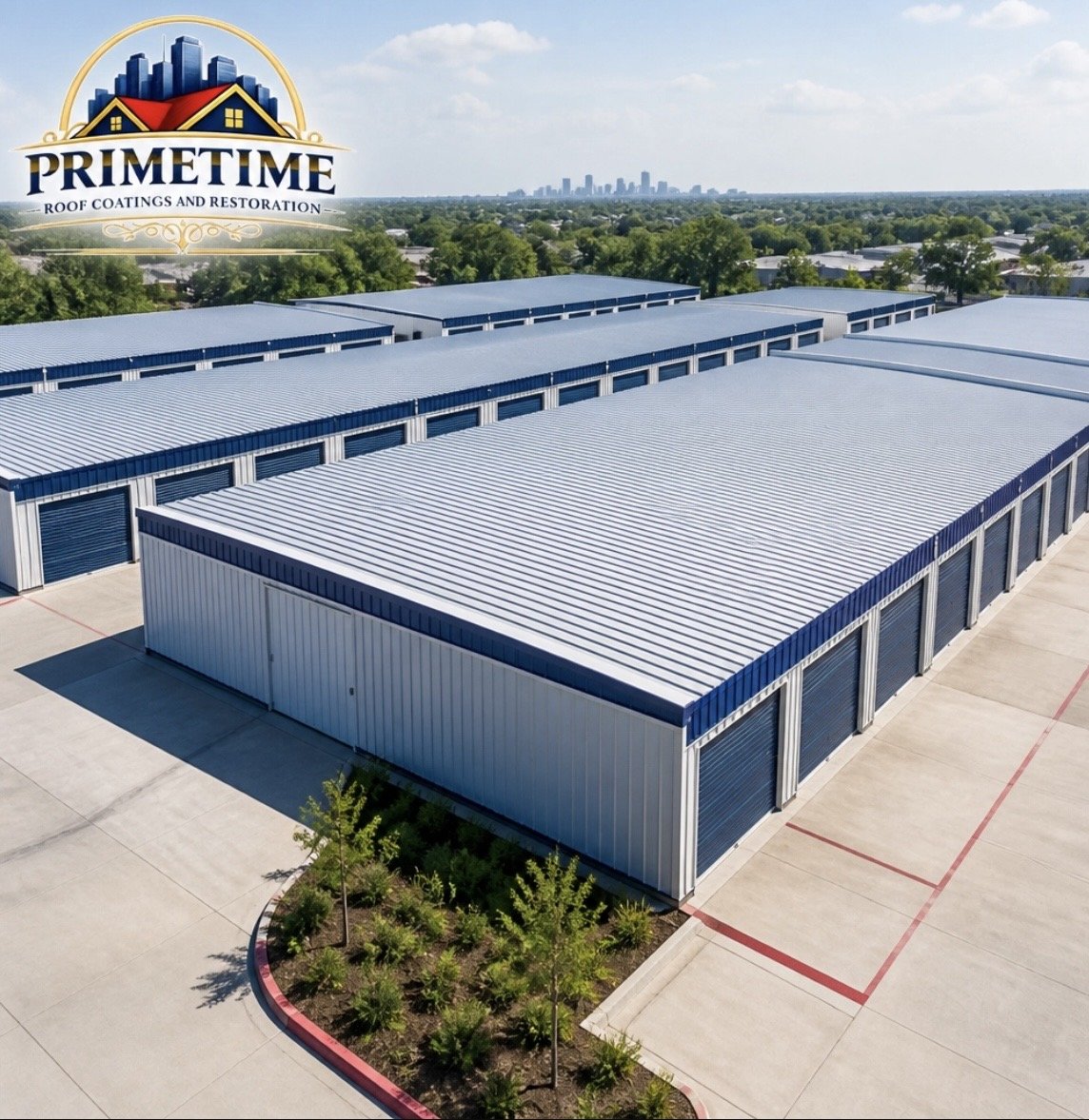
If your Roof Leaked Tonight… how many tenants would be affected tomorrow morning?
Most self-storage facility owners operate under a dangerous illusion. Because nobody lives inside the units and because properties are often managed remotely or through third-party REITs, the roof is treated as an out of sight, out of mind asset. That neglect creates a ticking financial time bomb. When a commercial roof fails at a storage facility, the damage extends far beyond a wet shingle or a damp drywall patch. It triggers a cascading failure of tenant property damage claims, aggressive insurance disputes, and catastrophic liability exposure.
At Primetime Roof Coatings and Restoration, our owner Anthony brings decades of hands-on experience in spray polyurethane foam and advanced roof coating systems across commercial sectors. Anthony has seen firsthand how deferred maintenance on large footprint facilities turns minor membrane fatigue into six-figure legal battles. If you own or manage properties in the Houston metro area, ignoring your roof is no longer an option.
The True Cost of a Self-Storage Roof Failure
When a roof fails on an office building or a retail strip, tenants experience temporary inconvenience. When a roof fails on a self-storage facility, tenants experience ruined inventory, destroyed family heirlooms, damaged business equipment, and immediate operational downtime.
The financial fallout hits fast. A single major downstorm can breach a neglected membrane, sending water cascading into dozens of individual units. Within hours, facility operators face angry tenants demanding compensation, carriers launching rigorous investigations, and a severe hit to brand reputation. Tenants who signed rental agreements expecting secure, dry storage quickly seek legal counsel.
Operating a facility requires proactive asset management. Whether you need a specialized self storage roof coating Houston property owners rely on, or emergency commercial roof repair self storage facility Woodlands managers trust, waiting for a tenant to report water pouring into unit 412 is a losing strategy.
Why Self-Storage Roofs Fail Faster Than Expected
Facility owners often assume that because their buildings are relatively straightforward single-story structures, the roofs should last for decades without intervention. Reality proves otherwise. Self-storage architecture presents unique structural vulnerabilities that accelerate wear and tear:
Massive Unbroken Membrane Spans: Long, low-slope flat roofs and expansive metal buildings experience severe thermal expansion and contraction under intense Texas sun. Without proper elastomeric protection, seams pull apart.
Severe Ponding Water: Low-slope designs frequently develop structural sagging over time. Water pools for days after a heavy rain, degrading TPO or modified bitumen membranes.
Heavy HVAC Penetrations: Climate-controlled units require dozens of rooftop HVAC units, curb flashings, and utility penetrations. Every single penetration is a potential leak point if sealants degrade.
Zero Daily Occupancy: Because buildings are locked and unattended for hours or days at a time, slow leaks develop into major saturation zones before anyone notices.
These vulnerabilities demand localized expertise. Dealing with a persistent flat roof leak self storage Pasadena operators face requires targeted diagnostic sealing, while managing a sprawling metal roof coating storage facility Baytown locations require calls for seamless liquid-applied reinforcement. Similarly, maintaining complex climate controlled storage roof maintenance Pearland facilities mandate requires specialized knowledge of internal humidity and insulation integrity.
The Liability Angle: Tenant Belongings and Insurance Realities
Texas commercial real estate law places significant responsibility on property operators to maintain safe, watertight premises. While standard self-storage lease agreements typically include liability waivers and require tenants to carry their own renter or commercial contents insurance, those waivers do not grant immunity against gross negligence or proven maintenance failures.
If an operator receives multiple reports of roof leaks, acknowledges the structural defect in writing or via prior maintenance logs, and fails to act before a storm destroys tenant property, liability exposure skyrockets. Insurance carriers providing commercial general liability policies often contest claims if they discover years of deferred maintenance and skipped annual inspections.
When managing assets across regions like Cypress or Katy, mitigating self storage roof leak liability Texas courts enforce requires documented proactive care. That is why professional oversight such as a rigorous self storage roof inspection Cypress operations undergo is vital for establishing a clear record of due diligence.
What a Proper Diagnostic Inspection Catches Before It Becomes a Claim
Most traditional roofing contractors offer a casual visual walkthrough from a ladder and call it a day. That superficial approach misses hidden subsurface saturation, fastener corrosion, and failing seam welds.
Anthony and our team at Primetime Roof Coatings and Restoration utilize a diagnostic-first protocol. We do not guess; we test. Our inspections incorporate:
Infrared Thermography: Non-invasive thermal imaging cameras detect trapped moisture beneath the roofing membrane long before interior water staining appears.
Core Cuts and Moisture Metering: We verify the exact condition of underlying insulation and decking to ensure the roof is a viable candidate for restoration rather than a costly full tear-off.
Seam and Flashing Stress Testing: We evaluate every perimeter termination, scupper, drain, and HVAC curb flashing for micro-cracks and material fatigue.
Catching these issues early transforms a potential five-figure tenant lawsuit into a straightforward preventive maintenance fix. For comprehensive storage facility roof restoration Katy TX building owners can verify, our diagnostic reports provide absolute clarity on structural health.
When facility owners face aging, leaking roofs, many assume their only option is a complete tear-off. A full commercial roof replacement is disruptive, messy, and staggering in cost. It shuts down facility access, frustrates tenants, and generates massive landfill waste.
There is a superior engineering alternative. Modern fluid-applied elastomeric coatings and Spray Polyurethane Foam (SPF) systems offer a smarter path:
Cost Efficiency: Roof restoration typically costs up to 50 percent less than a complete tear-off and replacement.
Seamless Waterproofing: Liquid-applied silicone or elastomeric membranes cure into a monolithic, seamless barrier that completely eliminates fastener pull-outs and joint leaks.
Energy Savings: High-reflectivity white coatings reflect up to 85 percent of solar radiation, cutting interior cooling loads for climate-controlled units by 10 to 15 percent annually.
Extended Warranties: Our systems come backed by 10, 15, or 20-year transferable warranties covering both labor and materials.
Minimal Disruption: Projects are completed quickly with zero disruption to tenant access or daily business operations.
Stop Gambling With Your Facility Assets Today
Ignoring your self-storage roof does not make the risk go away. It only magnifies the cost when failure finally strikes. Whether your property spans 5,000 square feet or 100,000 square feet across the Houston metro area, protecting your investment requires an expert eye and a proactive restoration strategy.
Take control of your facility's operational security today. Contact Primetime Roof Coatings and Restoration to schedule your no-obligation commercial roof health assessment. No pressure, no sales gimmicks, just honest engineering answers from experienced professionals.
Call us directly at 832-447-1170 or visit our team online to secure your property before the next major Texas storm hits.
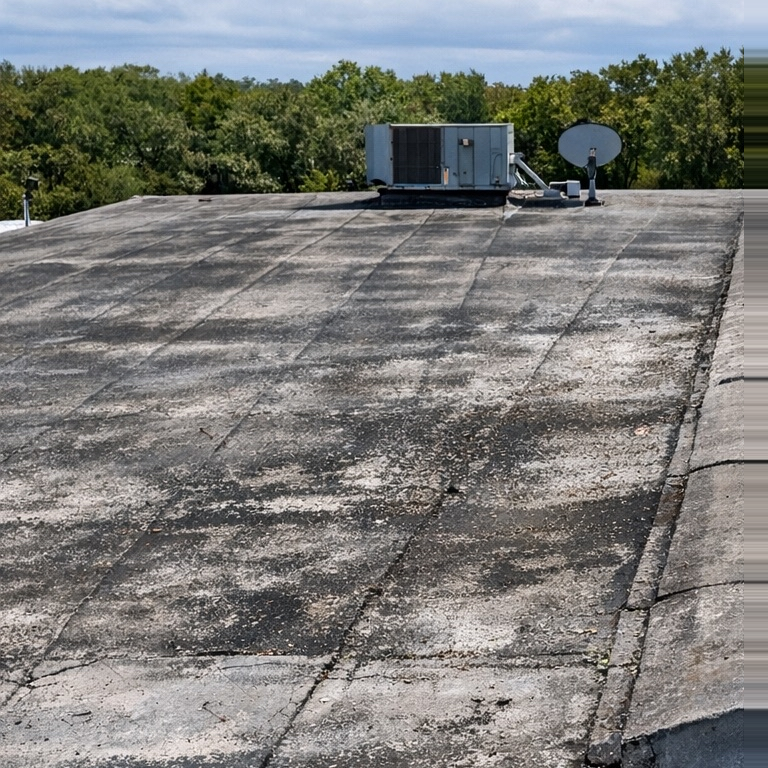
"The $200K Roofing Mistake Houston Schools and Warehouses Keep Making"
If you manage a school, daycare, warehouse, or commercial property in the Houston area, you already know the pattern: the roof gets ignored until it leaks, and then it becomes an emergency instead of a line item. By the time it's an emergency, you're no longer choosing the most cost-effective solution. You're choosing whatever stops the bleeding fastest, usually at the highest price.
Here's how to get ahead of that cycle, what a commercial roof coating and restoration approach actually costs compared to a full reroof, and why the number your first contractor quotes you is often not the number you actually need to spend.
Most roof problems don't require a full reroof
The default assumption in commercial roofing is that an aging or leaking flat roof means it's time to tear it off and start over. In practice, that's true far less often than the industry lets on.
A full reroof is the easiest number for a contractor to quote. It doesn't require diagnosing what's actually failing, and it comes with a bigger price tag. But most commercial roofs that are 15 to 25 years old with isolated leaks or wear are strong candidates for restoration: targeted repairs combined with a roof coating system that can extend the roof's life another 10 to 15 years, often for a fraction of what a full reroof costs.
The difference matters most for organizations working within a fixed annual budget, like school districts, daycares, and municipal or nonprofit facilities. A six-figure reroof doesn't just cost money. It displaces money that would otherwise go toward staff, programs, equipment, or students.
Which roof coating system fits your building
Not every roof restoration looks the same, and the right coating system depends on your existing roof type, drainage, and sun exposure:
SPF (spray polyurethane foam) roof coatings work well for older, uneven, or ponding-prone flat roofs, since the foam can be applied to build a slope for better drainage while adding insulation value.
Silicone roof coatings hold up especially well in Houston's climate, resisting ponding water and UV degradation better than many alternatives, which makes them a common fit for flat commercial roofs with drainage challenges.
TPO roof restoration is often the right call for buildings with an existing TPO membrane that's still structurally sound but showing seam wear or surface degradation, extending its service life without a full tear-off.
A proper diagnostic identifies which of these fits your roof's condition, rather than defaulting to a one-size-fits-all recommendation.
When to start budgeting, before the emergency
Commercial roof repair rarely lines up with when the money is actually available unless you plan for it. A few timing patterns are worth building into your calendar:
Q3 to Q4 (August through November): most commercial capital budgets for the following year are finalized during this window. If your roof needs attention, this is when to get a diagnostic and a quote, so the repair has a chance of making it into next year's approved budget instead of becoming an unplanned emergency expense.
November to December: organizations with unspent capital budget often look to deploy it before fiscal year-end. If a roof repair has already been identified and quoted, this is often when it gets approved and scheduled.
January 1 insurance renewals: many commercial insurance policies renew at the start of the calendar year, and insurers increasingly require a roof condition report before renewal. Getting ahead of this in the fall avoids a scramble in December.
School district budget cycles: Texas ISDs typically build facilities budgets on a cycle tied to board approval well before a July 1 fiscal year start, often beginning as early as January. Getting a diagnostic and cost estimate in hand before that planning process starts gives facilities directors a real number to work with, instead of a guess.
What a diagnostic-first approach actually looks like
A proper diagnostic means someone walks the roof, identifies exactly where it's failing and why, and gives you options: what needs to happen now, what can wait, and what the actual cost range looks like for repair versus full replacement. It should be possible to walk away from that diagnostic with a real number for both paths, not just a reroof quote.
If a contractor recommends a full reroof without doing this first, it's worth asking directly: what would a targeted repair and coating system cost instead? A contractor who can't answer that question clearly hasn't actually diagnosed your roof.
Where we work
Primetime Roof Coatings & Restoration provides commercial roof diagnostics, coatings, and restoration across the greater Houston area, including The Woodlands, Pasadena, Baytown, and Pearland, serving warehouses, schools, daycares, shopping centers, and industrial facilities throughout these communities.
Frequently asked questions
How much does commercial roof restoration cost compared to a full reroof? Costs vary by roof size, condition, and coating system, but restoration is typically a fraction of a full reroof's cost, since it avoids tear-off, disposal, and full membrane replacement. A diagnostic visit gives you an exact number for your building.
How long does a roof coating last? A properly applied SPF, silicone, or TPO restoration coating can extend a roof's service life by 10 to 15 years, depending on the existing roof's condition and the coating system used.
Does my roof need a full reroof or just a restoration? That depends on the roof's structural condition, age, and how it's failing. A diagnostic evaluation, not a quote based on a quick visual walk, is the only reliable way to know.
What areas does Primetime serve? Primetime works with commercial, institutional, and industrial properties throughout the greater Houston area, including The Woodlands, Pasadena, Baytown, and Pearland.
The bottom line
The roofs that end up costing the most are usually the ones nobody looked at until something failed. Getting a diagnostic before your budget planning cycle, not after a leak forces the issue, is the difference between a roof repair that fits your budget and one that blows it up.
Primetime Roof Coatings & Restoration offers diagnostic-first roof evaluations for commercial, institutional, and industrial properties across the Houston area, so you know exactly what your roof needs and what it will cost before you have to make a decision under pressure.
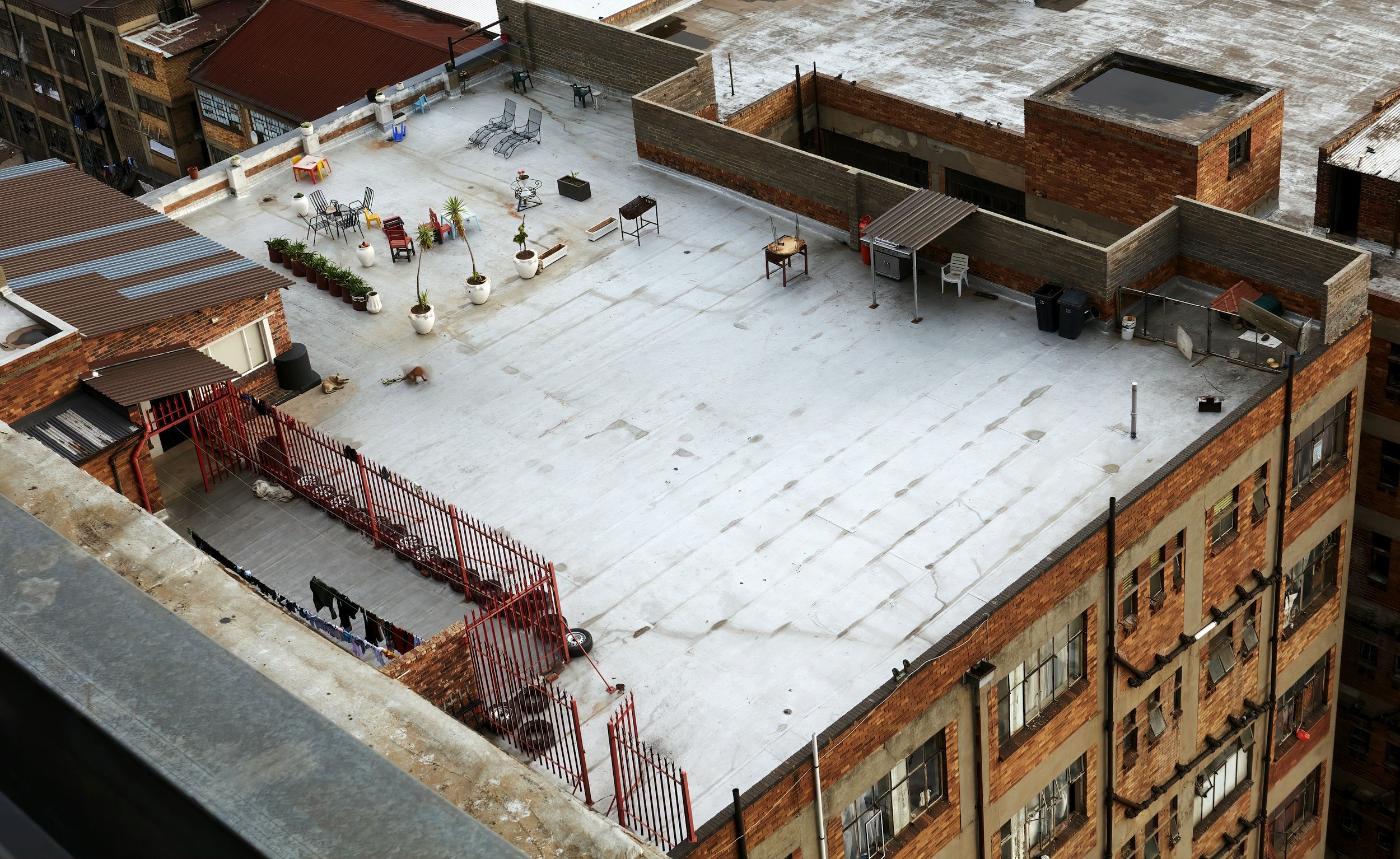
Wind and Water Damage After a Gulf Storm: A Commercial Property Owner's Checklist
After a tropical storm or heavy Gulf Coast rain event, commercial property owners often don't realize how much damage their roof sustained until weeks later. In the Houston metro area, the immediate focus is usually on debris removal and power restoration. However, the silent threat to your asset's ROI is the invisible compromise of your roofing system.
Wind uplift and water intrusion are the primary culprits behind premature roof failure. If you manage a warehouse in Pasadena, a retail center in Baytown, or an industrial facility in La Porte, waiting for a visible leak is a high-stakes gamble. This checklist provides the direct, technical framework needed to assess damage, document findings for insurance, and determine if you need a temporary patch or a full restoration.
How to Spot Commercial Roof Wind Damage in Houston
Wind damage is rarely as obvious as a fallen tree. For commercial flat roofs, damage is often mechanical and structural. High-velocity winds create pressure differentials that can physically lift the roof membrane away from the substrate.
1. Wind Uplift Damage and Flat Roof Signs
"How to tell if wind damaged my commercial roof" is a question that starts at the edges. Look for lifted or peeled membranes at the corners and perimeters. These areas are the most vulnerable to wind uplift. If you see ripples, wrinkles, or sections of the membrane that no longer lie flat, the adhesive or mechanical fasteners have likely failed.
2. Metal Panel and Edge Displacement
For those requiring metal roof wind damage repair in Houston, look for displacement. High winds can rattle metal panels, loosening fasteners and creating gaps. Check the "coping" (the metal cap on top of the parapet walls). If it is loose, missing, or bent, the structural integrity of the roof edge is compromised, inviting water to travel under the system.
3. Debris Punctures and Scrapes
Gulf storms carry flying debris. Even a small branch can puncture a TPO or PVC membrane. These punctures are difficult to spot from the ground but are the #1 cause of a commercial roof leak after storm Houston events.
Identifying Water Intrusion: What to Do After Heavy Rain
Water damage is progressive. Once the "envelope" is breached, the clock starts ticking on your insulation and internal structures.
4. Detecting Interior Leaks and Ceiling Staining
The most obvious sign of water intrusion commercial roof what to do scenarios is the interior drip. However, "storm water damage ceiling commercial property" often starts as a faint yellow or brown ring. If you see bubbling paint or sagging ceiling tiles in your facility, water has already saturated the insulation.
5. Managing Ponding Water
A flat roof leaking after heavy rain Houston is often the result of "ponding." While most roofs are designed to handle water for 48 hours, a storm can shift debris into scuppers and drains. If you see standing water deep enough to submerge seams days after the clouds have cleared, your drainage system is failing. This weight puts immense stress on the structure and accelerates membrane degradation.
6. Insulation Saturation
You don't need a hole in the ceiling to have a problem. Trapped moisture in the polyiso insulation board destroys its R-value and creates a breeding ground for mold. This is why professional inspectors use infrared thermography and moisture meters: to find what the naked eye misses.
Technical Documentation: What Adjusters Look For
When filing a claim, your word isn't enough. You need data. Public adjusters and insurance carriers require "photo documentation roof damage insurance claim" evidence that is timestamped and localized.
The Professional Documentation Checklist:
High-Resolution Overview Photos: Use drone photography to capture the entire roofscape.
Detailed Damage Close-ups: Document every lifted seam, displaced fastener, and debris puncture.
Moisture Readings for Roof Insurance Claims: Use a calibrated moisture meter to prove saturation. An adjuster is much more likely to approve a restoration if you can show a 20% vs. 5% moisture differential in the substrate.
Weather Data Integration: Match your findings with NOAA wind speed reports from the day of the storm to establish "proximate cause."
If you are working with a public adjuster roof inspection Houston specialist, having a contractor who speaks their language: using technical terms like "uplift pressure" and "capillary action": is the difference between a denied claim and a fully funded restoration.
Repair vs. Mitigation: Choosing the Right Response
Not every storm requires a total tear-off. In fact, Primetime Roof Coatings & Restoration specializes in avoiding them.
Emergency Roof Repair and Tarping
If you have an active leak over expensive inventory or machinery, you need emergency roof repair Houston commercial services immediately. This may involve a commercial roof tarping service Houston or temporary sealants. These are mitigation steps designed to "stop the bleed."
24-Hour vs. Long-Term Restoration
While 24 hour roof leak repair Houston services are necessary for immediate relief, they are not a long-term solution. A patch is a band-aid. If the storm damage is widespread but the substrate is still dry, a Commercial Roof Restoration using a high-solids silicone or elastomeric coating can restore your roof to "better than new" condition at 50% of the cost of a replacement.
Hurricane Season Preparedness and Local Expertise
Living on the Gulf Coast means "hurricane season roof preparedness Houston" is a year-round job. Whether you need storm damage roof repair Pasadena TX or a commercial roof repair Baytown after storm season, the key is proactivity.
Don't wait for the next "Big One" to find out your roof was compromised by the last one. Small breaches in your roof's defense today become catastrophic failures tomorrow.
FAQs: Common Storm Damage Questions
How do I know if my roof has storm damage?
Look for interior ceiling stains, ponding water that lasts more than 48 hours, or metal trim that appears loose or bent. If you haven't had an inspection since the last major wind event, assume there is hidden damage.
Will my insurance cover a roof coating after a storm?
Many insurance companies will cover the cost of restoration if it can be proven that wind or hail compromised the existing membrane. This is why professional documentation and moisture mapping are critical.
How long do I have to file a claim?
Most policies have a "prompt notice" requirement. While you might have a year to file, the longer you wait, the harder it is to prove the damage was caused by a specific storm rather than general wear and tear.
Stop the Damage. Secure Your Asset.
A storm-damaged roof is a liability that grows every time it rains. Primetime Roof Coatings & Restoration provides the "no-nonsense" technical assessments you need to satisfy insurance adjusters and protect your bottom line.
No pressure. No obligation. Just answers.
Call us at 832-447-1170 or click below to schedule your free, professional storm damage roof assessment. We’ll provide the documentation, the moisture maps, and the cost-effective restoration plan you need to get back to business.
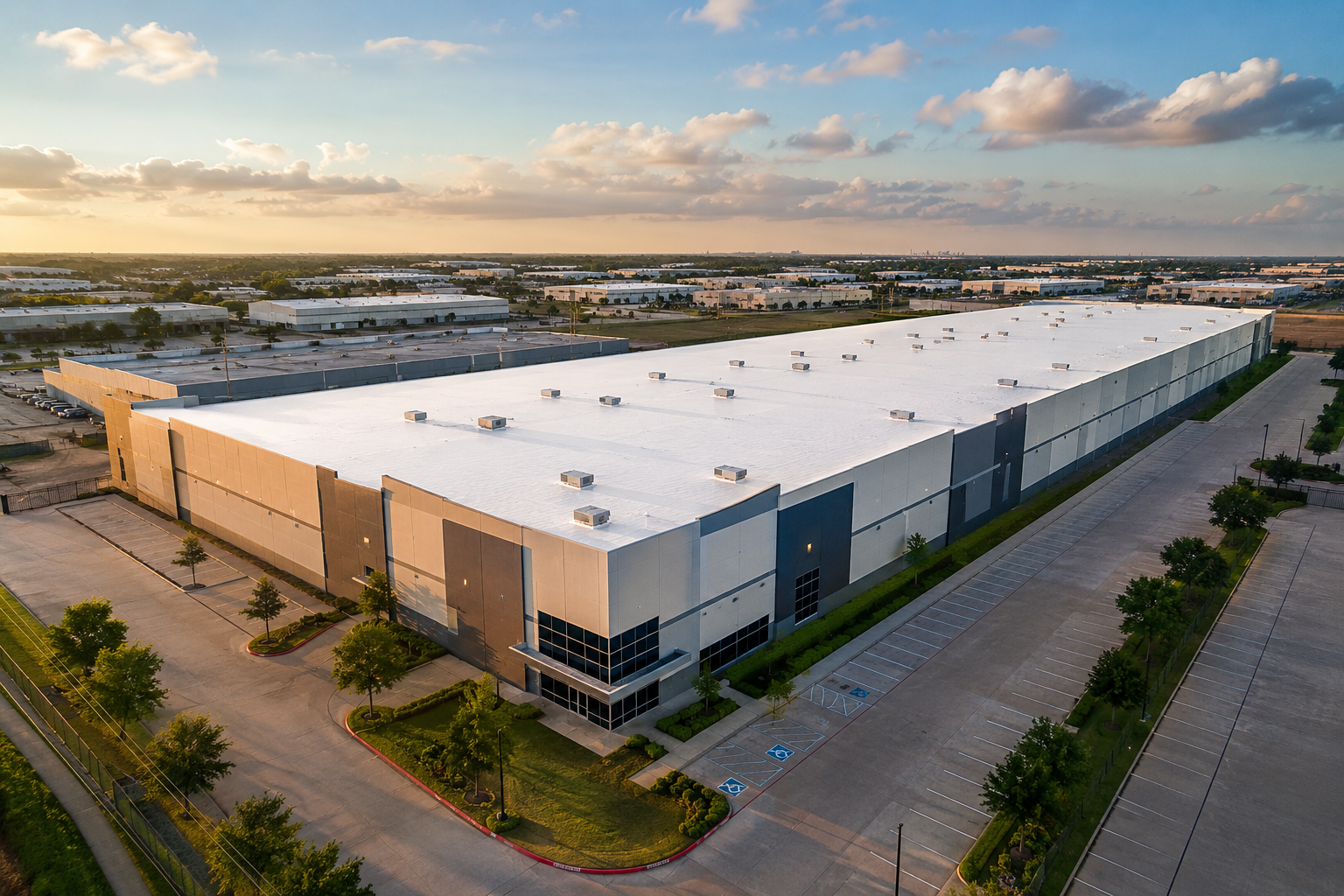
SILICONE ROOF RESTORATION VS. REPLACEMENT:WHICH IS BETTER FOR YOUR HOUSTON COMMERCIAL BUILDING?
Full TPO replacement can cost 2-3x more than silicone restoration and Houston’s ponding water could void most TPO warranties. Here’s the real cost breakdown for property managers deciding between the two.
Stop wasting capital on roof replacements you don't need. Start restoring.
For Houston property managers and facility directors, the "replace vs. restore" debate isn't just about maintenance: it’s about financial logic. In a city where humidity is a constant and annual rainfall exceeds 50 inches, your roof isn't just a cover; it’s a liability or an asset.
In 2026, the trend has shifted. Leading firms are moving away from the "tear-off and replace" cycle of traditional TPO (Thermoplastic Polyolefin) and moving toward high-performance silicone restoration. Why? Because the ROI of a silicone coating is objectively superior when your existing substrate is structurally sound.
If you are managing a facility with more than 5,000 square feet, here is the no-nonsense breakdown of why silicone is beating TPO in the Houston market.
The Financial Logic: Cost Comparison 2026
Let’s talk numbers. You have a budget to manage, and a full TPO replacement is a capital-intensive project that often involves unnecessary waste and labor.
TPO Full Replacement: Typically costs between $8.00 and $14.00 per square foot in the Houston metro area. This price skyrockets if you have to tear off multiple existing layers or replace saturated insulation.
Silicone Roof Restoration: Costs between $4.00 and $6.00 per square foot.
By choosing restoration over replacement, you are looking at an immediate 50% to 70% cost savings. For a 20,000-square-foot warehouse, that is a $100,000+ difference that stays in your operating budget.
85% Less Labor, 100% Less Disruption
A full TPO tear-off is a logistical nightmare. It involves heavy machinery, massive dumpsters, and days: if not weeks: of noise and debris that disrupt your business operations.
Silicone restoration requires 85% less labor than a full replacement. We don't tear your roof off; we repair, clean, and coat it. There are no dumpsters blocking your loading docks and no noise driving your tenants away. We get in, restore the integrity of your building, and get out in a fraction of the time.
The Houston Problem: Ponding Water
Houston's climate is brutal. Our heavy rain cycles lead to "ponding water": standing water that remains on your roof for more than 48 hours. This is where TPO fails and silicone shines.
Most TPO manufacturers specifically exclude damage caused by ponding water from their warranties. TPO is a membrane with seams. When water sits on those seams for days, the adhesive weakens, the membrane shrinks, and leaks become inevitable.
Silicone is different. High-solids silicone is chemically engineered to be "moisture-cure." It doesn't just resist water; it is completely unaffected by it. Silicone can withstand indefinite ponding water without degrading. In the Bayou City, where drainage is rarely perfect, silicone is the only pragmatic choice for long-term protection.
Is Your Roof a Candidate for Restoration?
Not every roof can be saved. If your insulation is 100% saturated or your deck is structurally compromised, you may need a replacement. However, if your roof is simply "aged" and starting to leak at the seams or penetrations, you are the prime candidate for a restoration.
At Primetime, we don't guess. We perform professional commercial roof inspections to determine the exact condition of your substrate. We look for:
Moisture Infiltration: We identify if the insulation is dry.
Adhesion: We ensure the coating will bond permanently to your existing TPO, metal, or modified bitumen roof.
Structural Integrity: We verify the deck is sound.
Conclusion: Stop Replacing, Start Restoring
If you are managing a commercial property in Houston, Katy, The Woodlands, or Sugar Land, you need a roofing partner who understands the bottom line. Silicone coatings are the most efficient, cost-effective, and climate-appropriate solution for 2026.
Don't wait for the next Houston storm to find your roof's weak points.
Contact Primetime Roof Coatings & Restoration today. No pressure. No obligation. Just a professional assessment of how much you can save by restoring instead of replacing.
832-447-1170
Why we walk away from patch only roof jobs
Last month, a Houston-area property manager called us with a simple request: patch a section of their flat roof that had started leaking. Fast, cheap, done by Friday.
We turned it down.
Not because we didn't want the work. Because the roof didn't need a patch. It needed real restoration, and a patch would have failed within a year, leaving the property with a bigger repair bill and a client who felt misled when the same leak came back.
This is a decision we make often, and it's worth explaining why, because it's a question every commercial property owner in the Houston metro area should be asking their roofing contractor.
What a Patch Actually Fixes (and What It Doesn't)
A patch addresses the symptom, not the cause. If a flat, metal, or TPO roof is leaking because of an isolated, localized issue, a targeted repair can be the right call. But when a roof is in poor overall condition, ponding water has been sitting for years, seams have failed in multiple locations, or the membrane has broken down across a wide area, a patch only buys time. It doesn't solve the underlying problem, and it often makes the eventual restoration more expensive because the damage keeps spreading underneath a surface that now looks fine.
We've seen this pattern play out again and again across Houston's flat, metal, and TPO commercial roofs. Gulf Coast heat, humidity, and storm cycles are unusually hard on roofing systems, and a patch that might hold up in a milder climate often fails much faster here.
Our Policy, and Why We Hold to It
Primetime Roof Coatings does not perform patch-only work on roofs in poor condition. If a roof needs full restoration, that's what we recommend, even when a patch would be the easier sale.
This isn't a marketing angle. It comes directly from how our lead technician approaches every roof: with a background in coatings R&D at BASF and equipment design at Carlisle, the priority has always been getting the underlying chemistry and application right, not just making a problem temporarily invisible. A roof that's coated or restored correctly the first time costs less over its lifespan than one that gets patched repeatedly.
What We Do Instead
Before we recommend anything, we run a diagnostic assessment, including thermal imaging and moisture scanning, to understand the roof's actual condition. That data tells us, and tells you, whether a targeted repair genuinely makes sense, or whether the roof needs a full coating system or restoration to actually solve the problem.
Sometimes that means a phased approach: addressing the most urgent section now, with a documented plan for the rest of the roof over the following months, so the cost doesn't have to hit all at once. What it doesn't mean is a patch on a roof that's already past the point where a patch will hold.
What This Means for You
If you manage a commercial property with a flat, metal, or TPO roof in the Houston metro area and you're getting quotes for repair work, ask your contractor one question: has this roof been assessed for its overall condition, or are we just talking about the leak you can see?
If the answer is the second one, you're not getting the full picture, and you may be looking at the same conversation again in twelve months.
We offer free diagnostic roof scans for Houston-metro commercial properties, no obligation, so you can find out what condition your roof is actually in before spending a dollar on repair, coating, or replacement.
Call us directly at 832-447-1170.